


 EN
EN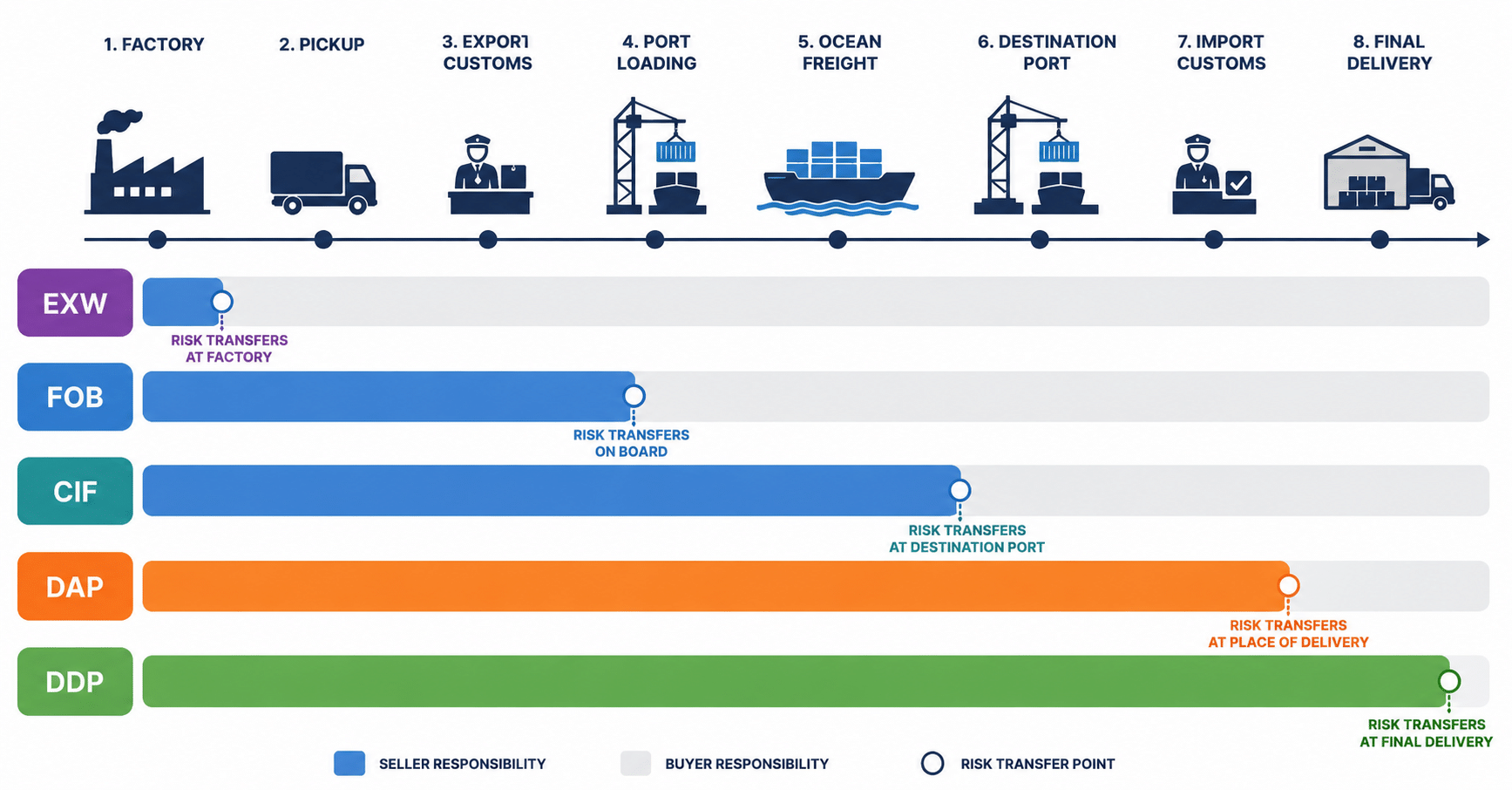
For a first-time importer, the shipping term on a quote can matter as much as the unit price. Understanding FOB vs CIF cabinets terms is often the least understood line on the whole document, yet it can quietly reshape total landed cost.
This trips up new buyers specifically because the price difference between an FOB and a CIF quote looks like a discount or a markup, when it's actually a difference in who's responsible for what. This guide is written for wholesalers and distributors importing cabinets for the first time, trying to understand a quote before they're deep into contract negotiation. It covers what FOB and CIF mean in practice, how they change what you're responsible for, where DDP fits in, and how to know which one makes sense for your first order.
Why Shipping Terms Matter More Than They Seem
A shipping term—technically part of a broader set called Incoterms—defines exactly where the seller's responsibility ends and the buyer's begins, for cost, risk, and logistics. Getting this wrong when comparing FOB vs CIF cabinets terms doesn't just cause confusion; it can mean unexpected costs showing up after the goods are already at sea, or unclear liability if something goes wrong in transit.
This matters more for cabinets specifically than for smaller goods, since cabinets are bulky, often container-based, and freight costs make up a meaningful share of total landed cost. That means shipping terms cabinet import decisions genuinely shift the math on a quote, not just the paperwork.
FOB Explained: Free On Board
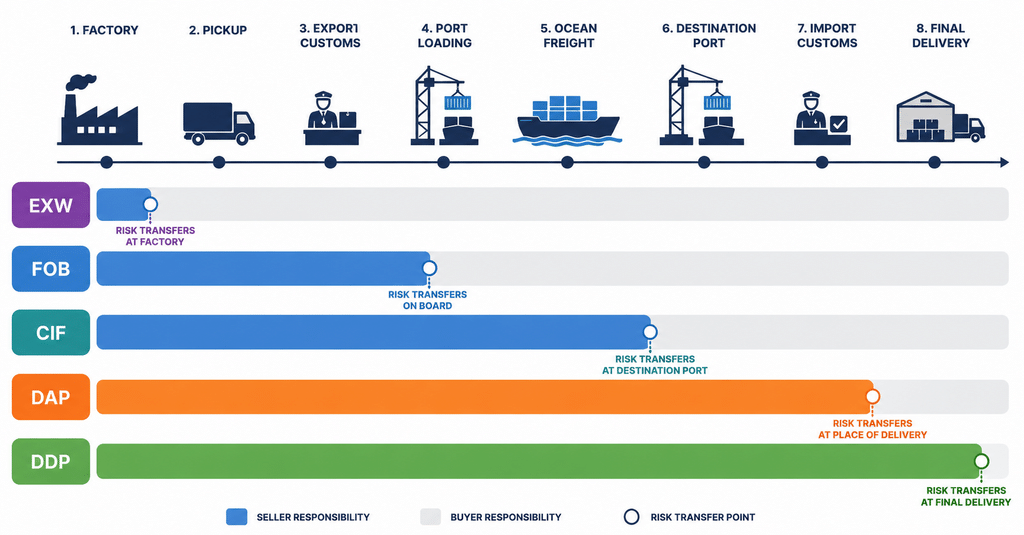
Under FOB, the seller's responsibility ends once the goods are loaded onto the shipping vessel at the port of origin. From that point forward, the buyer arranges and pays for ocean freight, insurance, and everything on the receiving end—customs clearance, import duties, and final delivery.
Buyers often choose FOB when comparing FOB vs CIF cabinets options because it offers more control over freight forwarding and insurance, and often a lower total cost if the buyer already has a freight relationship or is shipping at volume. The trade-off is more moving parts to manage directly, which can be a real learning curve for someone importing for the first time.
CIF Explained: Cost, Insurance, and Freight
Under CIF, the seller handles and pays for ocean freight and insurance up to the destination port—the quoted price already includes these costs. The buyer still handles customs clearance, import duties, and inland transport from the port to their final location.
Buyers often choose CIF for a first import because it requires fewer logistics relationships to set up upfront, since the manufacturer is already coordinating freight and insurance. This is where cif high quality cabinets sourcing becomes attractive for a new buyer specifically: the manufacturer's existing freight network can smooth over a gap in the buyer's own logistics experience. The trade-off is less visibility and control over freight costs, since they're baked into the manufacturer's quote rather than negotiated separately.
FOB vs CIF: Where the Responsibility Actually Shifts
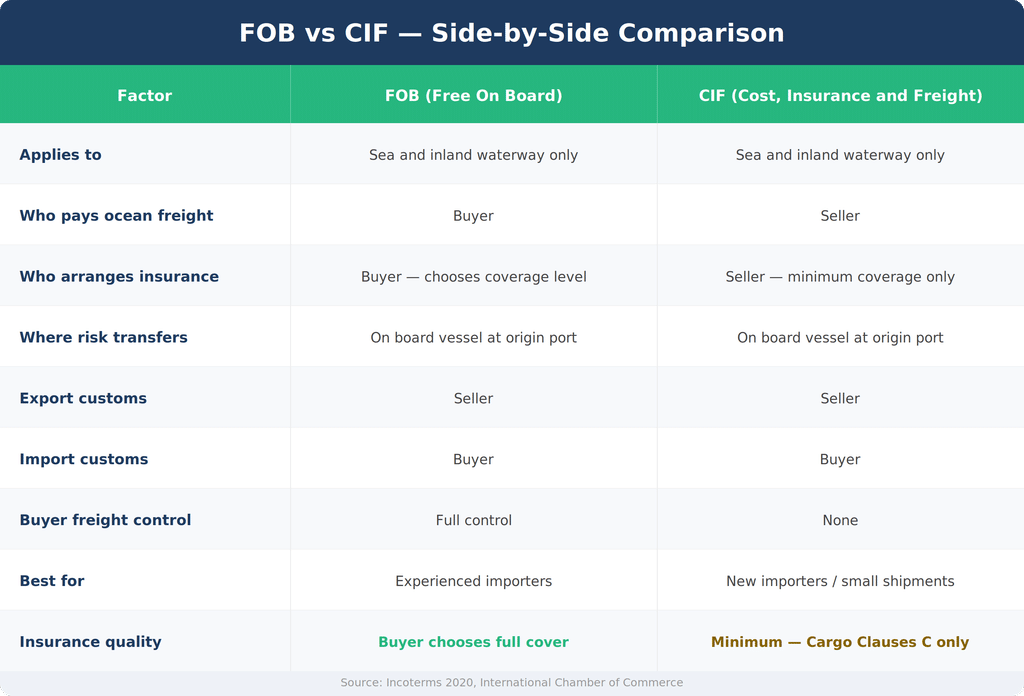
The clearest way to understand FOB vs CIF cabinets terms is side by side, since the responsibility split isn't always intuitive from the names alone.
| FOB | CIF | |
| Ocean freight | Buyer arranges and pays | Included in seller's quote |
| Marine insurance | Buyer arranges separately | Included in seller's quote |
| Risk transfer point | Once goods are loaded at origin port | Once goods are loaded at origin port (same as FOB—insurance just covers the journey) |
| Customs clearance (import) | Buyer's responsibility | Buyer's responsibility |
| Import duties | Buyer's responsibility | Buyer's responsibility |
| Freight forwarder relationship needed | Yes | Not necessarily, for the ocean leg |
| Cost visibility | Freight cost separate and negotiable | Bundled into unit price |
The detail that surprises a lot of first-time importers: risk technically transfers to the buyer at the same point under both terms. The real difference in FOB vs CIF cabinets agreements is who's paying and arranging freight and insurance, not who bears the risk during the voyage.
Which One Is Actually Cheaper?
Neither term is inherently cheaper—the real cost depends on whether the buyer or the seller can secure better freight and insurance rates. A buyer with an established freight forwarder relationship or high shipping volume often gets a better rate under FOB by handling freight themselves.
A first-time importer without freight relationships may end up paying a similar or even lower effective cost under CIF, simply because the manufacturer already has established shipping rates and volume discounts. The only way to actually compare FOB vs CIF cabinets pricing is to request both an FOB and a CIF quote from the same supplier for the same order, and compare total landed cost—not just the quoted unit price.
Does the Manufacturer Handle Customs Under CIF?
A common misconception in FOB vs CIF cabinets discussions is that CIF means the seller handles import customs clearance or duties. It doesn't. Under CIF, the manufacturer's responsibility stops at the destination port—customs clearance, import duties, and inland transport from the port are still the buyer's responsibility.
This misunderstanding causes real problems when buyers assume CIF means a "hands-off" import, then get caught off guard by customs paperwork or an unexpected duty bill. This is exactly why the next term—DDP—exists for buyers who want that responsibility handled too.
Where DDP Fits In
DDP, or Delivered Duty Paid, means the seller handles everything—freight, insurance, customs clearance, and import duties—delivering the goods to the buyer's specified location, duties already paid. This appeals to first-time importers because it requires the least amount of logistics and customs complexity to manage directly.
The trade-off is that DDP is typically the highest quoted price of the three terms, since the seller is absorbing and pricing in every step of the process. DDP can still make sense for a first order despite the higher price because of predictability—a single, all-in number is often worth more to a first-time buyer weighing FOB vs CIF cabinets options than a lower price with more unknowns.
A Quick Comparison: FOB vs CIF vs DDP
| Responsibility | FOB | CIF | DDP |
| Freight | Buyer | Seller | Seller |
| Insurance | Buyer | Seller | Seller |
| Import customs & duties | Buyer | Buyer | Seller |
| Inland delivery | Buyer | Buyer | Seller |
| Buyer's logistics involvement | Highest | Moderate | Lowest |
| Typical quoted price | Lowest (freight separate) | Middle | Highest (all-in) |
How to Choose the Right Term for Your First Import
If freight relationships and cost control matter most, and there's capacity to manage logistics directly, FOB tends to offer the most flexibility and potential savings when weighing FOB vs CIF cabinets options.
If simplicity and fewer moving parts matter more than shaving freight cost, CIF is a reasonable middle ground for a first order. If predictability and minimal logistics involvement matter most, even at a premium, DDP removes the most uncertainty.
The practical move regardless of which term looks best on paper: ask the supplier for quotes under more than one cabinet freight terms option, and compare total landed cost side by side before deciding.
Learn more: Why Choose Vietnam for Cabinet and Furniture Manufacturing?
Questions to Ask a Manufacturer Before Your First Order
Before finalizing a decision on FOB vs CIF cabinets, or DDP, run through these questions with any potential supplier:
- Can you provide quotes under FOB, CIF, and DDP so I can compare total landed cost?
- Under CIF, what exactly is covered—and what still falls on me after the goods reach port?
- Do you have a preferred freight forwarder relationship I can use even under FOB?
- What documentation will I need to handle customs clearance myself?
- Are there other fees not reflected in the quoted shipping term (port handling, demurrage, inland trucking)?

Supplier Spotlight: Casta Cabinetry
As a practical reference point for how these terms actually work with a real manufacturer, it's worth looking at how Casta Cabinetry supports buyers navigating FOB vs CIF cabinets decisions.
Founded in 2002, Casta is a Vietnam-based manufacturer specializing in kitchen cabinets, vanities, and custom furniture, with over two decades in the industry. The company operates two factories spanning more than 100,000 m², using European machinery from brands including SCM, Homag, and Cefla, with manufacturing automation reaching roughly 90%.
Learn more: Sourcing Cabinets and Furniture from Vietnam: Your Ultimate Guide
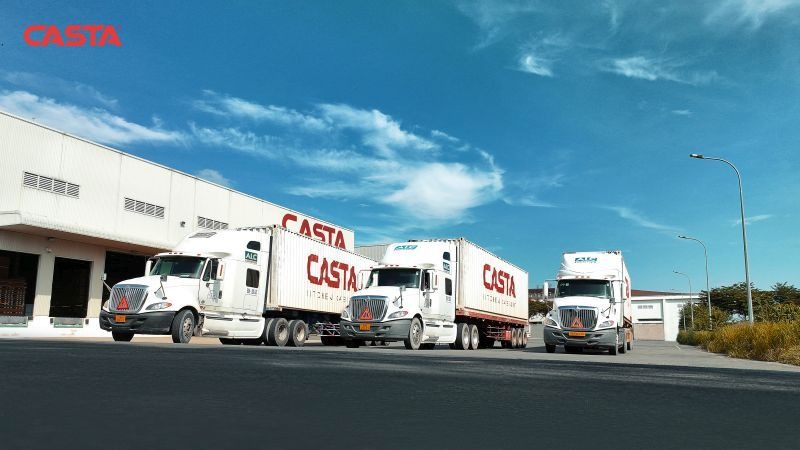
Over 80% of production is exported, primarily to the U.S., supported by a dedicated logistics team managing port-to-door delivery and customs processes for buyers who prefer more supported terms. This kind of online cif distribution cabinet factory support matters most for buyers without an established freight relationship of their own, since the manufacturer's team can walk through documentation and options directly rather than leaving a first-time importer to figure it out alone.
Learn more: Logistics & Import: Streamlining the Shipping and Customs Process
Sales and service offices in California, Texas, and New York give first-time importers a direct point of contact to walk through shipping term options before committing. Production capacity runs up to 150 containers per month, with a standard lead time of 45–60 days from shop drawing approval, and the company offers samples until clients are fully satisfied with design, materials, and finish before a full production run begins.
The right shipping term depends on a buyer's own logistics setup and experience level. The most useful next step, whether comparing FOB vs CIF cabinets or considering DDP, is a direct conversation to compare quotes under different terms for a specific order.
Breaking Down Total Landed Cost
Understanding FOB vs CIF cabinets terms is only half the picture—the other half is knowing what actually makes up total landed cost, since the quoted unit price under any term is rarely the full number a buyer ends up paying.
Total landed cost typically includes the unit price of the cabinets themselves, ocean freight (whether billed separately under FOB or bundled under CIF), marine insurance, import duties and tariffs, customs broker fees, port handling charges at both origin and destination, and inland trucking from the port to the buyer's final location. Missing even one of these line items when comparing FOB vs CIF cabinets quotes can make an FOB quote look artificially cheaper than it actually is once every cost is accounted for.
It's worth asking any supplier to itemize each of these components separately rather than accepting a single bundled total, regardless of which shipping terms cabinet import option is being considered. A transparent breakdown makes it possible to compare two quotes on equal terms, rather than comparing two numbers that quietly include different scopes of coverage.
Duties and tariffs deserve particular attention, since they can shift based on trade policy and vary by product classification—a rate that applied to a previous order isn't guaranteed to apply to the next one. Confirming current duty rates directly with a customs broker, rather than relying on a rate from a past shipment, is one of the more overlooked steps in accurately comparing FOB vs CIF cabinets total cost. This is especially relevant given how frequently trade policy and tariff schedules can shift, which makes a stale duty estimate one of the more common sources of budget surprises on a repeat import.
Learn more: Lead Times & Supply Chain Resilience: Navigating Potential Disruptions
Common Mistakes First-Time Importers Make
A few patterns show up often enough among new cabinet importers that they're worth flagging directly, since avoiding them early saves real money on a first order.
Comparing quoted unit price without accounting for shipping terms. A lower unit price under FOB isn't automatically a better deal than a higher unit price under CIF, since the FOB number doesn't include freight and insurance that still need to be added separately. Always compare total landed cost under FOB vs CIF cabinets options, not the line-item price alone.
Assuming CIF or DDP eliminates all logistics involvement. As covered earlier, CIF still leaves customs clearance and import duties with the buyer. Even DDP, which handles the most, still requires the buyer to be available to receive the shipment and verify the order against what was actually delivered.
Not asking about demurrage and detention fees upfront. These charges apply when a container sits at port longer than the free time allowed, and they can add unexpected cost regardless of which FOB vs CIF cabinets term was chosen. Asking about free time windows and per-day charges before an order ships avoids an unpleasant surprise later.
Choosing a term based on price alone rather than logistics readiness. The cheapest quoted term isn't the right choice if the buyer doesn't actually have the freight forwarder relationship or customs broker needed to execute it smoothly. A slightly higher-priced CIF or DDP arrangement that gets handled correctly is often better value than a lower FOB price that leads to costly mistakes on an unfamiliar first import.
FAQ
What is the difference between FOB and CIF for furniture imports?
Which shipping term is cheaper for cabinet buyers?
Does the manufacturer handle customs under CIF?
What does DDP shipping mean for cabinets?
Which Incoterm is best for a first-time cabinet importer?
Are there hidden fees under FOB or CIF that aren't in the quoted price?
Conclusion
FOB, CIF, and DDP aren't about which one is objectively best—they're about where responsibility shifts between buyer and seller, and how much logistics complexity a buyer wants to take on. For a first-time importer weighing FOB vs CIF cabinets options, the safest approach is requesting multiple quotes under different terms and comparing total landed cost, not just the number on the page.
Casta Cabinetry, with export experience and a dedicated logistics team supporting North American buyers, is a useful starting point for walking through these terms on a real order and getting a clear, itemized answer rather than a single bundled figure.
Ready to compare shipping terms for your first import? Contact Casta Cabinetry's team to request FOB, CIF, and DDP quotes and get a clear breakdown of what each one covers.





How Many Kitchen Cabinets Fit in a 20ft/40ft Container?...
For a wholesaler pricing out a bulk order, cabinets per container is the number that turns a quote into an actual budget...
09/20/2026 | David Nguyen

FSC Certified Cabinets: Why It Matters for Green Building Pr...
For a developer working on a certified green building project, FSC certified cabinets aren’t just a sustainability...
09/18/2026 | David Nguyen
Lead Time for Wholesale Cabinet Orders: From Factory to Deli...
For a developer or wholesaler working against a construction or renovation deadline, cabinet lead times aren’t a n...
09/16/2026 | David Nguyen

Cabinet Import Duties & Tariffs: What US Buyers Pay When...
For a U.S. wholesaler or importer, uncertainty around tariffs on imported cabinets is often the single biggest barrier t...
09/14/2026 | David Nguyen
How Many Kitchen Cabinets Fit in a 20ft/40ft Container?...
For a wholesaler pricing out a bulk order, cabinets per container is the number that turns a quote into an actual budget...
09/20/2026 | David Nguyen
FSC Certified Cabinets: Why It Matters for Green Building Pr...
For a developer working on a certified green building project, FSC certified cabinets aren’t just a sustainability...
09/18/2026 | David Nguyen
Lead Time for Wholesale Cabinet Orders: From Factory to Deli...
For a developer or wholesaler working against a construction or renovation deadline, cabinet lead times aren’t a n...
09/16/2026 | David Nguyen
Cabinet Import Duties & Tariffs: What US Buyers Pay When...
For a U.S. wholesaler or importer, uncertainty around tariffs on imported cabinets is often the single biggest barrier t...
09/14/2026 | David Nguyen
Contact us
Casta is always ready to listen and answer all customers' questions