


 EN
EN
How to choose cabinet supplies is the first call that determines whether a project runs smoothly or turns into a headache — cabinets typically make up 25–30% of a total kitchen renovation budget, so this one decision shapes your timeline, your margins, and your client's satisfaction. Get it wrong, and you're the one absorbing missed install dates and warranty calls months later.
This guide breaks down the 7 factors that separate a reliable long-term manufacturing partner from a risky one-time vendor, the mistakes to avoid, and what "custom" actually buys you — everything you need to make how to choose cabinet supplies a repeatable process instead of a gamble.
Why This Decision Matters More Than It Seems
Learning how to choose cabinet supplies isn't just a sourcing checkbox — it's a decision that shapes your margins, timelines, and reputation on every project that follows. Get it right once, and the payoff compounds; get it wrong, and the costs quietly stack up.
The Upside of Getting It Right
Choosing well pays off in ways that compound over time, not just on the first order:
- Consistent quality across every order, not only the sample batch or the first container.
- Reliable delivery schedules your project timeline can actually depend on, rather than best-case estimates that slip.
- Stronger margins from fewer returns, complaints, and rework — the hidden costs that eat into profitability on paper-thin bids.
- A brand reputation that compounds over repeat projects, because clients notice when quality doesn't waver.
The Risk of Getting It Wrong
The downside is just as real, and it tends to show up at the worst possible moment:
- Quality that swings from batch to batch, so the cabinets on order three don't match the sample that won you the bid.
- Delays that cascade into missed install dates, which ripple into every other trade waiting on cabinetry to go in first.
- Cost overruns from hidden fees and change orders that weren't disclosed at quoting.
- Communication breakdowns that slow down decisions when you need answers fast.
- A supplier who can't scale with your order volume as your business grows past their capacity.
How to Choose Cabinet Supplies: 7 Factors to Evaluate Before Choosing a Cabinet Supplier
1. Construction and Material Quality
If there's one place to start when figuring out how to choose cabinet supplies, it's what's inside the box, not what's on the door front. A cabinet built from 3/4-inch plywood or high-density MDF behaves very differently over ten years of daily use than one built from thin particleboard held together with staples. This is the single biggest lever for long-term durability, and it's usually visible if you know what to look for.
Joinery is the next tell, and it's a detail worth checking closely when working out how to choose cabinet supplies. Dovetail joints on drawer boxes distribute stress far better than staples and glue. Pocket-screw or doweled joints on face frames keep cabinets square through years of opening and closing. If a supplier's construction photos show staples where a joint should be, that's worth a direct question.
Learn more: Types of joints for cabinets
Hardware matters just as much as the box itself. Reputable, brand-name soft-close hinges and full-extension, under-mount drawer glides should be standard on any quote you're seriously considering — not a costly upgrade tacked on later.
Finish durability is easy to overlook until it fails, but it belongs on any checklist for how to choose cabinet supplies. Look for smooth, moisture- and wear-resistant finishes, ideally backed by third-party testing such as KCMA certification, which verifies weight capacity, drawer cycle counts, and heat and moisture resistance under laboratory conditions rather than a marketing claim.
Learn more: Material & Finish Innovations: Elevating Cabinet Design and Durability
2. Product Build Type and Customization
Understanding how to choose cabinet supplies starts with matching the build type to the project, not the other way around.
Stock/RTA cabinets are mass-produced in standard sizes, offering the fastest turnaround and the most budget-friendly pricing — a good fit for straightforward layouts on tight timelines.
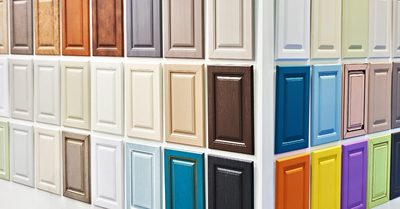
Semi-custom cabinets keep standard size increments but add flexibility on depth, drawer configuration, and finish selection, which covers most residential and light-commercial jobs without the cost of a full custom build.
Fully custom cabinets are built to exact specifications, which is the right call for unconventional layouts or highly specific design requirements — particularly for brands running their own product line.
Learn more: The difference of custom vs semi custom cabinets
One more thing worth checking: whether you're buying from a manufacturer directly or through a distributor layer. Working with a manufacturer directly often means better quality control and clearer communication, since there's no middle party diluting the answers you get on specs, timelines, or issues — another small but real factor in how to choose cabinet supplies well.
3. Manufacturing Capabilities and Scalability
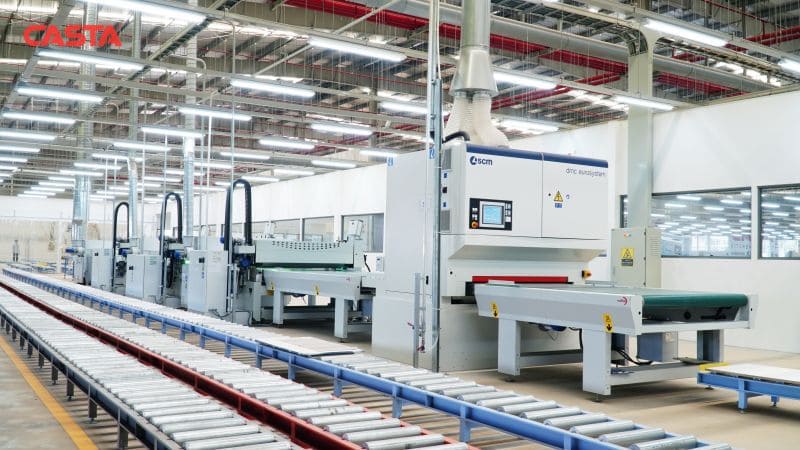
Manufacturing capability is where a lot of buyers underestimate how to choose cabinet supplies correctly — a beautiful showroom sample says nothing about whether the factory behind it can repeat that quality at volume. Ask whether the factory has the production capacity to support your current order — and whether it has room to grow with you. A supplier running near full capacity today may struggle once your volume doubles next year.
Manufacturing technology tells you a lot about consistency. CNC precision cutting and a high level of automation reduce the variability that comes from manual processes, which means order 500 looks like order 5.
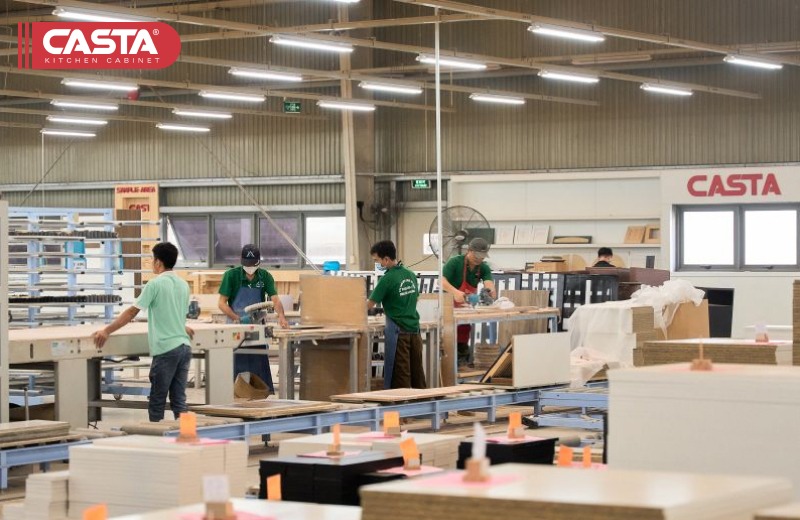
Quality control systems are the third piece, and one of the clearest signals in how to choose cabinet supplies you can trust at scale: incoming material inspection, in-process checks throughout production, and a final verification before anything ships. A supplier that only checks quality at the very end is relying on luck more than process.
Learn more: Why Choose Vietnam for Cabinet and Furniture Manufacturing?
4. Certifications and Compliance
Certifications are the fastest way to verify claims a supplier makes about quality and safety, rather than taking their word for it — and often the deciding factor in how to choose cabinet supplies from an unfamiliar overseas partner.
KCMA certification (Kitchen Cabinet Manufacturers Association) is the benchmark performance standard specifically for kitchen and bath cabinets in North America. To earn the ANSI/KCMA A161.1 seal, cabinets go through rigorous, independent lab testing: drawers are loaded at 15 pounds per square foot and cycled 25,000 times, wall-mounted cabinets are loaded to 600 pounds, doors are swung through 25,000 open-close cycles, and finishes are exposed to substances like vinegar, coffee, and alcohol to check for staining or discoloration. A supplier holding this certification has proven their cabinets survive real-world abuse, not just looked good in a showroom.
Emissions compliance is equally non-negotiable for anyone selling into the US market, and it's a core piece of how to choose cabinet supplies safely for that market. TSCA Title VI and CARB ATCM Phase 2 confirm that engineered wood and glues meet federal formaldehyde emission limits. Since March 2019, composite wood products manufactured or imported into the United States must carry TSCA Title VI certification from an approved third-party certifier, and non-compliant shipments can be held at customs or pulled from sale entirely.
Beyond those two, it's worth checking for FSC certification (sustainable forestry sourcing), ISO quality management standards, and BSCI/BSI social and safety compliance — each one adds a layer of verification that reduces your risk further down the supply chain.
Learn more: Cabinet certifications
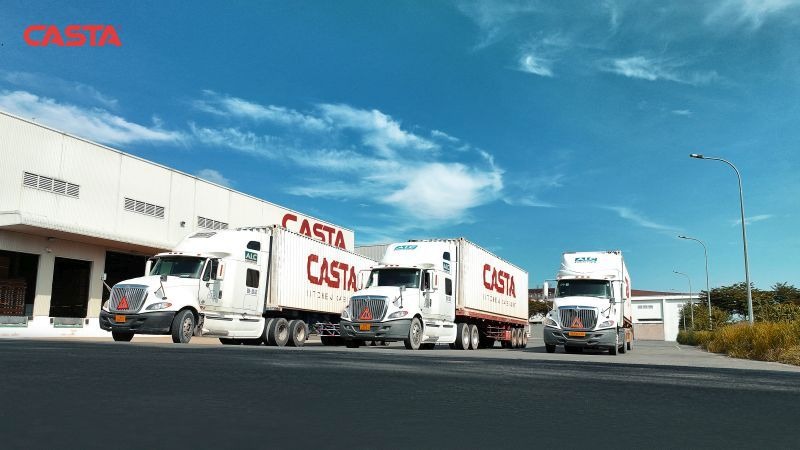
5. Lead Times and Supply Chain Reliability
Realistic lead times vary a lot by build type, and they're one of the most overlooked parts of how to choose cabinet supplies. Stock cabinets often ship within days to two weeks. Custom orders can run 6 to 10-plus weeks depending on complexity and the supplier's current order backlog.
There's a real trade-off between domestic and imported sourcing. Domestic manufacturing tends to offer more predictable logistics but at a meaningful price premium. Imported sourcing can bring real cost savings, but it requires accounting honestly for customs clearance and ocean freight timelines rather than assuming everything arrives on the fastest possible schedule.
The most important question to ask directly: are the lead times you're quoted guaranteed, or are they best-case estimates? A supplier's willingness to commit to a realistic number — and explain what happens if they miss it — tells you a lot about how they'll handle the rest of the relationship.
Trade and tariff policy can shift from year to year, so it's worth building some flexibility into your sourcing plan rather than treating any single factory relationship as fixed. Working with a manufacturer that can adapt — in pricing, logistics, or production scheduling — helps absorb that uncertainty without disrupting your supply chain. Variables like these are exactly why how to choose cabinet supplies is an ongoing evaluation, not a one-time decision.
Learn more: Vietnam vs China Cabinet Manufacturers: A Comparative Analysis
6. Design Support and Communication
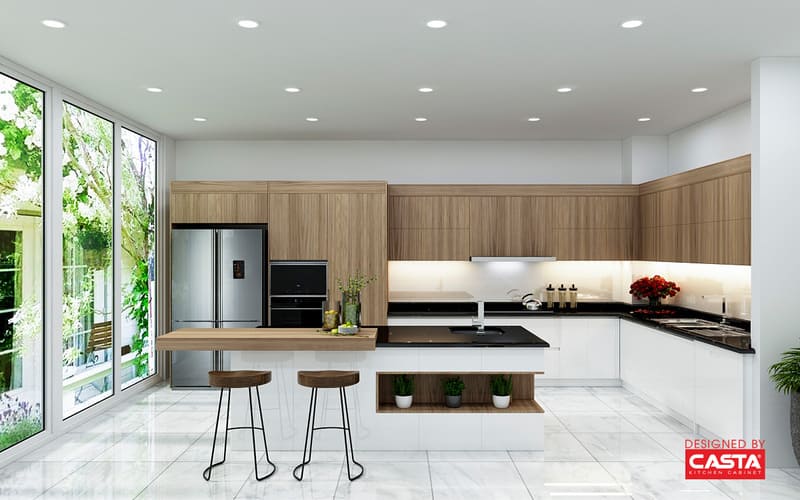
Design and communication rarely make the top of anyone's list when researching how to choose cabinet supplies, but they're often what separates a smooth project from a stressful one. Strong suppliers back up their production capability with real design support: 3D renderings, technical drawings, and shop drawings that catch layout problems on a screen instead of on-site, where fixes cost far more.
Measurement verification is a smaller detail that matters more than it seems. Reliable suppliers confirm dimensions themselves rather than working solely off rough specs you send over — that extra check is often what prevents a shipment of cabinets that don't fit.
Responsiveness during the quoting stage is an early, reliable signal of what post-sale communication will look like, and a practical test to apply while working out how to choose cabinet supplies. If a supplier is slow or vague before they've won your business, that pattern rarely improves afterward.
7. Warranty and After-Sales Support
A baseline worth expecting: coverage on manufacturing defects and hardware, ideally in the range of a limited lifetime warranty, or at minimum 5 years on cabinets and 10 years on hardware. Warranty terms under 1–5 years on core construction are a red flag worth noting — they suggest the manufacturer doesn't have much confidence in their own product holding up.
Just as important as the warranty terms themselves is how claims are actually handled: how quickly damaged or warped units get replaced, and how disputes get resolved when there's disagreement about what caused a defect. A generous warranty on paper means little if the claims process takes months. This is the last, and most overlooked, piece of how to choose cabinet supplies you can actually trust after the sale closes.
Common Mistakes Buyers Make When Choosing a Supplier
Even experienced buyers fall into a handful of recurring traps — and most of these mistakes trace back to skipping a step in how to choose cabinet supplies rather than a lack of experience:
- Prioritizing unit price over total cost — freight, customization fees, rework, and returns can erase whatever was saved on the quoted per-unit price.
- Skipping physical samples and relying only on renderings or showroom lighting, which can make a finish look better than it performs in real conditions.
- Not confirming certifications with actual documentation — a claim on a website isn't the same as a certificate you can verify.
- Underestimating lead times and how they interact with the rest of a project schedule, especially when multiple trades are waiting on cabinetry.
- Treating "custom" and "quality" as the same thing — a custom order from a poorly controlled supplier is still a risk, just a more expensive one, and a common trap in how to choose cabinet supplies for a first-time overseas order.
Understanding how to choose cabinet supplies really comes down to avoiding these specific mistakes rather than chasing a single "best" supplier — the fundamentals matter more than the brand name on the quote.
Learn more: Kitchen cabinet buying guide
The Advantages and Benefits of Custom Cabinet Manufacturers
For contractors and brands working on higher-end or highly specific projects, there are real advantages of choosing custom kitchen cabinet manufacturers over stock or semi-custom alternatives:
- Design flexibility to match unconventional layouts, brand specifications, or private-label program requirements exactly.
- Tighter alignment between product and end-customer expectations, which matters especially for brands reselling under their own name.
- OEM/ODM capability for companies building out their own product line rather than reselling someone else's stock designs.
The trade-off worth weighing honestly: longer lead times and typically higher unit cost, offset by fewer downstream fit and satisfaction issues once the product is installed. This is exactly the kind of trade-off that should factor into how to choose cabinet supplies for any project where fit and finish carry real weight. For many buyers, the benefits of choosing custom kitchen cabinet manufacturers show up less in the initial order and more in the absence of callbacks and complaints months later — one more reason custom capability belongs on any list of how to choose cabinet supplies for a private-label program.
Cabinet Supplier Evaluation Checklist
Use this as a working reference the next time you need to decide how to choose cabinet supplies for a new project or supplier relationship — run through it before signing, not after.
- [ ] Construction and material specs verified
- [ ] Certifications confirmed with documentation (KCMA, CARB, TSCA, FSC, ISO, BSCI, BSI)
- [ ] Lead times confirmed as realistic and guaranteed, not best-case
- [ ] Samples requested and reviewed under real lighting conditions
- [ ] Warranty terms reviewed in writing
- [ ] References or case studies checked
- [ ] Communication tested during the quoting stage
Supplier Spotlight: Casta Cabinet
Founded in 2002, Casta is a Vietnam-based manufacturer specializing in kitchen cabinets, vanities, and custom furniture, with over two decades in the industry. We built our operation around the same criteria outlined above, because it's exactly what serious B2B buyers check for before signing a contract. If you're still working through how to choose cabinet supplies for your own project, the facts below are meant to be checked, not taken on faith.
Manufacturing scale and technology: Casta operates two factories spanning over 100,000 m², running European machinery from brands including SCM, Homag, and Cefla, with manufacturing automation reaching roughly 90%. CNC panel cutting holds ±0.1 mm precision, and PUR hot-melt edge sealing adds extra moisture resistance to every panel edge — the kind of manufacturing depth that matters when evaluating how to choose cabinet supplies at scale.
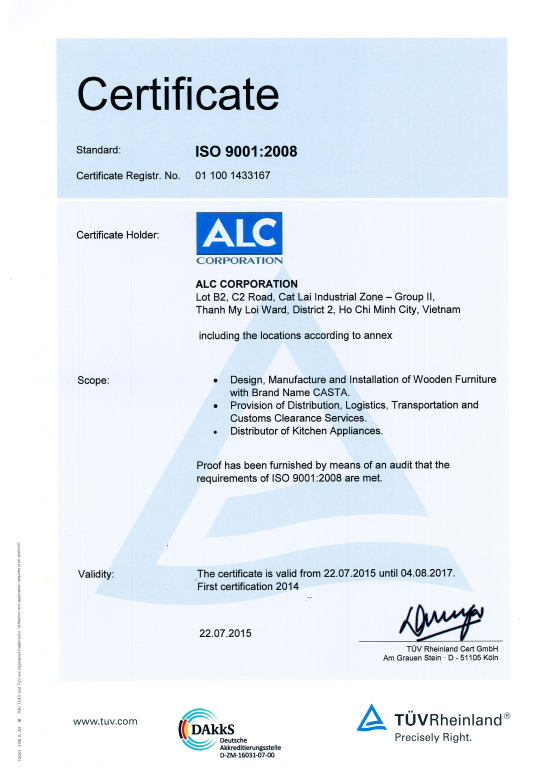
Certifications: Materials are sourced to meet global standards including European E1, JIS, CARB, and FSC certifications, alongside BSI and BSCI social compliance certifications. Casta follows TCVN ISO 9001:2015 quality management standards and holds KCMA certification.
Capacity and lead times: Production capacity reaches up to 200 containers per month, with a standard lead time of 45–60 days from shop drawing approval — a number we treat as a commitment, not a best-case estimate, and exactly the kind of detail worth confirming when deciding how to choose cabinet supplies for a large order.
Export experience: Over 80% of production is exported, primarily to the United States, supported by sales and service offices in California, Texas, and New York for direct, local communication rather than routing everything through a single overseas contact.
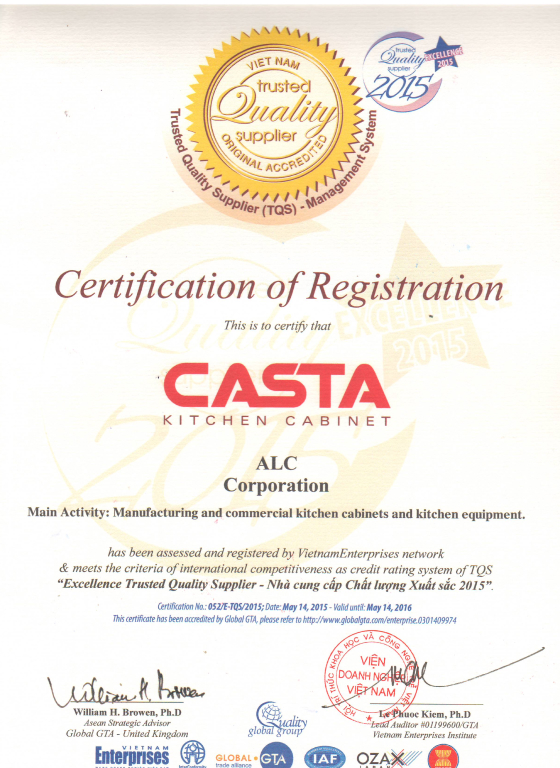
Track record: Casta supplies large corporations including Vinhomes, Masterise Homes, Gamuda Land, and Dai Quang Minh, and has been recognized as a "Gold Trusted Quality Supplier" and awarded "Vietnam Competitive Trademark Winner."
Sample policy: We offer samples until clients are fully satisfied with design, materials, and finish before production begins — because we'd rather resolve questions on a sample than on a container of finished product.
This isn't meant as a hard sell. It's a factual reference point to evaluate against the criteria above, not a claim that Casta is the right fit for every buyer, but a real-world example of what the answer to how to choose cabinet supplies can look like in practice.
Learn more: Casta’s outstanding international projects
Frequently Asked Questions
How do I choose the right kitchen cabinet company?
What are the advantages of choosing a custom kitchen cabinet manufacturer?
What are the most common mistakes when choosing a cabinet manufacturer?
How do I choose a reliable kitchen cabinet manufacturer?
What certifications should a cabinet supplier have?
Conclusion
Learning how to choose cabinet supplies isn't about finding the single cheapest quote — it's about weighing construction quality, certifications, lead times, and warranty terms together, since price alone tells you almost nothing about how a supplier will perform on order twenty. The strongest suppliers are transparent about all four of these areas; a weak or vague answer on any one of them is usually a signal to keep looking.
Casta Cabinet, with certified materials, scalable production, and a direct presence supporting North American buyers, is one option worth evaluating against this checklist — and one more data point in how to choose cabinet supplies you can actually rely on, order after order.
Contact Casta Cabinet's team to request samples, discuss your project, or schedule a factory consultation.





Private Label Cabinet Branding: Custom Packaging & Label...
Putting your name on a cabinet line is one of the fastest ways for a retailer or brand to build margin and customer loya...
09/24/2026 | David Nguyen

Cabinet Quality Control Process: How Bulk Orders Are Inspect...
For a wholesaler buying from overseas, the biggest fear usually isn’t price. It’s opening a container weeks ...
09/22/2026 | David Nguyen

How Many Kitchen Cabinets Fit in a 20ft/40ft Container?...
For a wholesaler pricing out a bulk order, cabinets per container is the number that turns a quote into an actual budget...
09/20/2026 | David Nguyen

FSC Certified Cabinets: Why It Matters for Green Building Pr...
For a developer working on a certified green building project, FSC certified cabinets aren’t just a sustainability...
09/18/2026 | David Nguyen
Private Label Cabinet Branding: Custom Packaging & Label...
Putting your name on a cabinet line is one of the fastest ways for a retailer or brand to build margin and customer loya...
09/24/2026 | David Nguyen
Cabinet Quality Control Process: How Bulk Orders Are Inspect...
For a wholesaler buying from overseas, the biggest fear usually isn’t price. It’s opening a container weeks ...
09/22/2026 | David Nguyen
How Many Kitchen Cabinets Fit in a 20ft/40ft Container?...
For a wholesaler pricing out a bulk order, cabinets per container is the number that turns a quote into an actual budget...
09/20/2026 | David Nguyen
FSC Certified Cabinets: Why It Matters for Green Building Pr...
For a developer working on a certified green building project, FSC certified cabinets aren’t just a sustainability...
09/18/2026 | David Nguyen
Contact us
Casta is always ready to listen and answer all customers' questions