EN
A dresser looks simple on a spec sheet. Multiply it by 300 rooms, tie it to an opening date, and every small detail becomes a schedule risk. That is why the choice among hotel casegoods manufacturers deserves more attention than it usually gets.
This guide is for hospitality developers and procurement firms evaluating Vietnam-based hotel casegoods manufacturers. It covers what casegoods include, how FF&E procurement flows, what to put in a spec, how prototype approval works, and seven checks to run before you bid.
What Hotel Casegoods Are
Before you compare hotel casegoods manufacturers, get the vocabulary straight. Bids go wrong when two suppliers price different things under the same word.
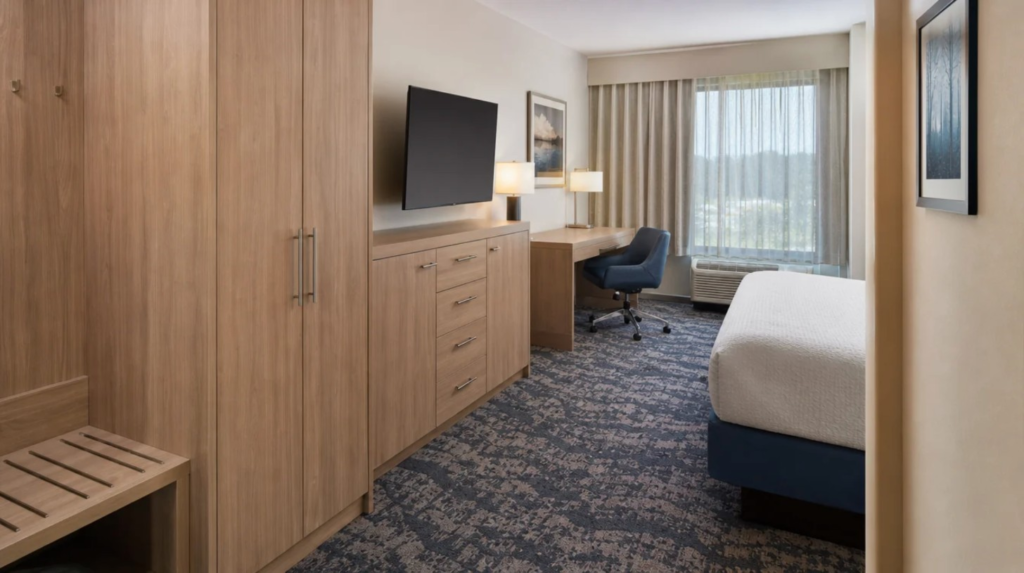
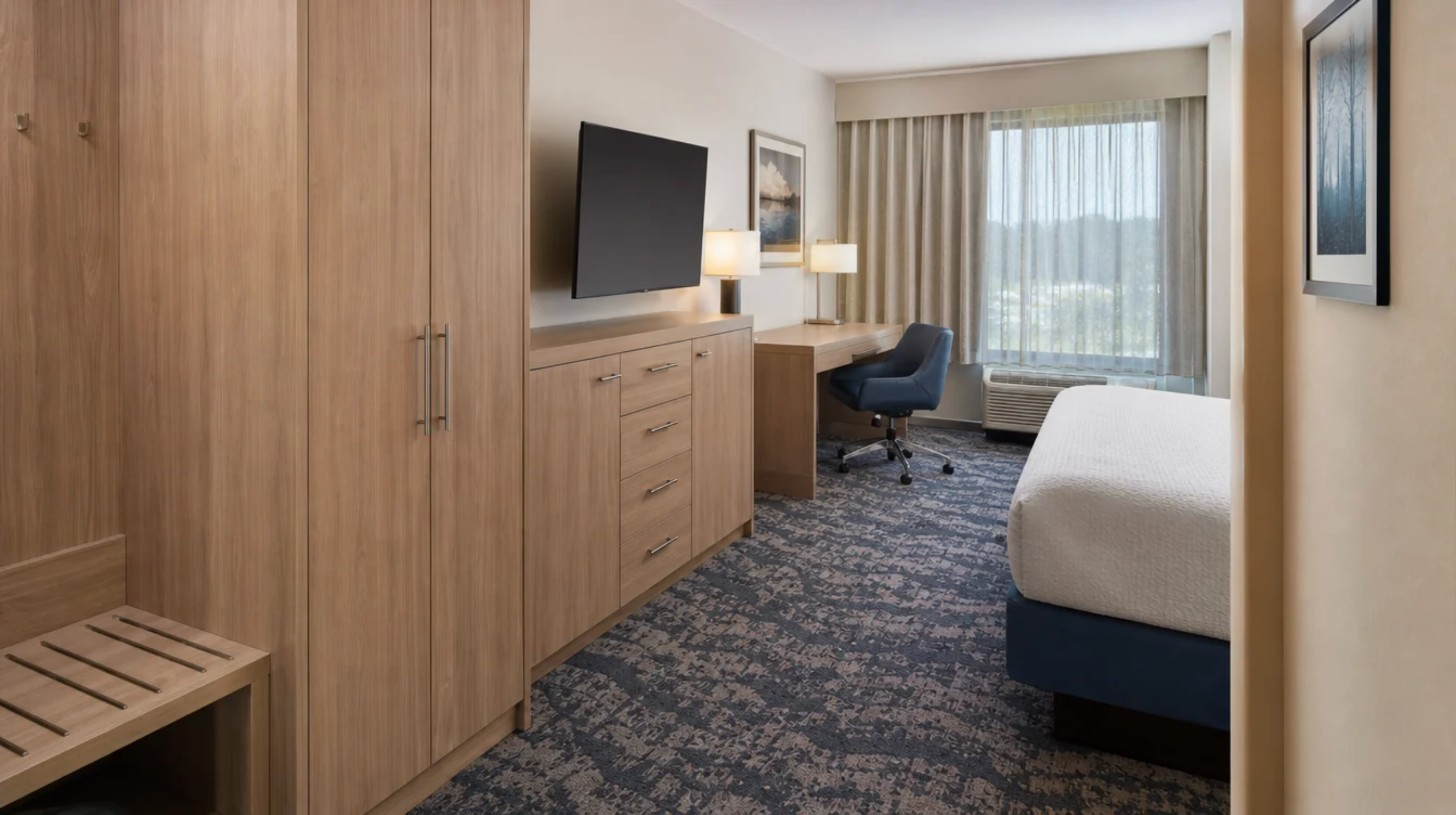
- Casegoods are the non-upholstered, wood-based pieces in a room: dressers, nightstands, desks, credenzas, TV consoles, and luggage benches.
- Built-in furniture is fitted to the room. Think wardrobes and closets, vanities, minibar and coffee cabinets, headboard panels, and wall-mounted units.
- Loose furniture is freestanding. It can be moved or replaced separately.
The distinction matters for scheduling. Built-ins are drawn to the room and installed alongside the construction schedule, while loose casegoods follow the FF&E delivery schedule. Some hotel room casegoods manufacturers handle one group, some handle both, and you need to know which before you send an RFQ.
A typical guestroom package lists each piece by room type, with finishes, hardware, and quantities per key. A hotel room casegoods manufacturer that works from this kind of schedule can price quickly. One that asks you to explain it from scratch will slow the whole bid.
How FF&E Procurement Typically Flows
FF&E stands for furniture, fixtures, and equipment. On most hotel projects it moves through the same eight steps, and the manufacturer's job is to fit into that chain without causing a delay.
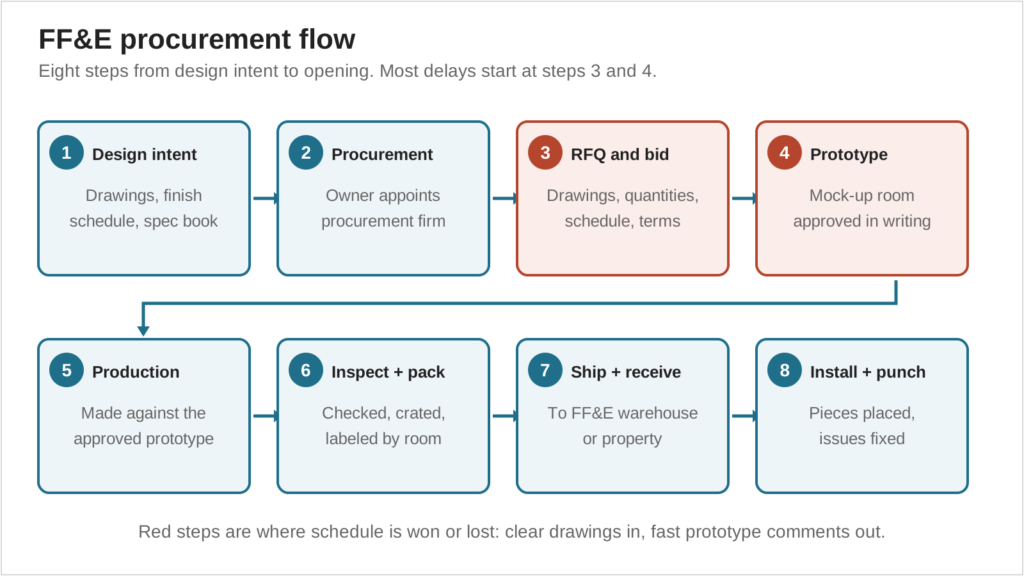
- Design intent. The interior designer issues drawings, finish schedules, and a spec book.
- Procurement setup. The owner or developer appoints a procurement firm or purchasing agent. Brand standards may restrict approved suppliers or specifications.
- RFQ and bid. Hotel casegoods manufacturers receive drawings, quantities, schedule, and delivery terms, then return pricing and lead times.
- Award and prototype. The selected manufacturer builds a prototype or mock-up room, and the owner, designer, and brand approve it.
- Production. The full order is made against the approved prototype.
- Inspection and packing. Goods are checked, crated, and labeled by room.
- Shipping and receiving. Goods ship to an FF&E warehouse or the property.
- Installation and punch list. Pieces are placed, issues are logged, and fixes are finished before opening.
Most delays on hospitality jobs start in steps 3 and 4, not in the factory. Late drawings, unclear finish references, and slow prototype comments push production back, and the opening date does not move. A good supplier can protect you here by sending clear questions early and keeping the approved prototype as the single reference.
Learn more: New Construction Cabinet Packages for Homebuilders and Developers
Why Hospitality Buyers Look at Vietnam
Many hospitality buyers already source from one country and want a second option. Vietnam is often that option. Buyers who search for hotel casegood manufacturers by country first tend to see it appear again and again.
- Diversified sourcing. Buyers who want choices beyond a single sourcing country often add Vietnam-based hotel casegoods manufacturers to their supplier mix.
- Wood furniture capability. Vietnam has a large wood furniture industry with real experience in export programs.
- Capacity and technology. Larger hotel casegoods manufacturers use modern machinery and automation for consistent output across a long run of identical rooms.
- A competitive cost structure. Budgets per key are tight, so factory-direct pricing matters.
- Duties and tariffs. Treat these as a verified cost, not an assumption. Confirm the HTS classification and current duties for each product category with a customs broker, and do not rely on a general claim from a supplier that goods are tariff-free.
The last point catches buyers out more than any other. A bid that looks cheaper by 4% can end up more expensive once duties, freight, and insurance are added. Compare hotel furniture manufacturing quotes on landed cost, not on the factory price alone, and hold every hospitality furniture supplier to the same basis.
Learn more: Cabinet Import Duties & Tariffs: What US Buyers Pay When Importing from Vietnam
What to Define in a Casegoods Specification
The spec book is the only thing every bidder sees. If it is loose, you get quotes that cannot be compared, and a prototype that argues about things the book never said.
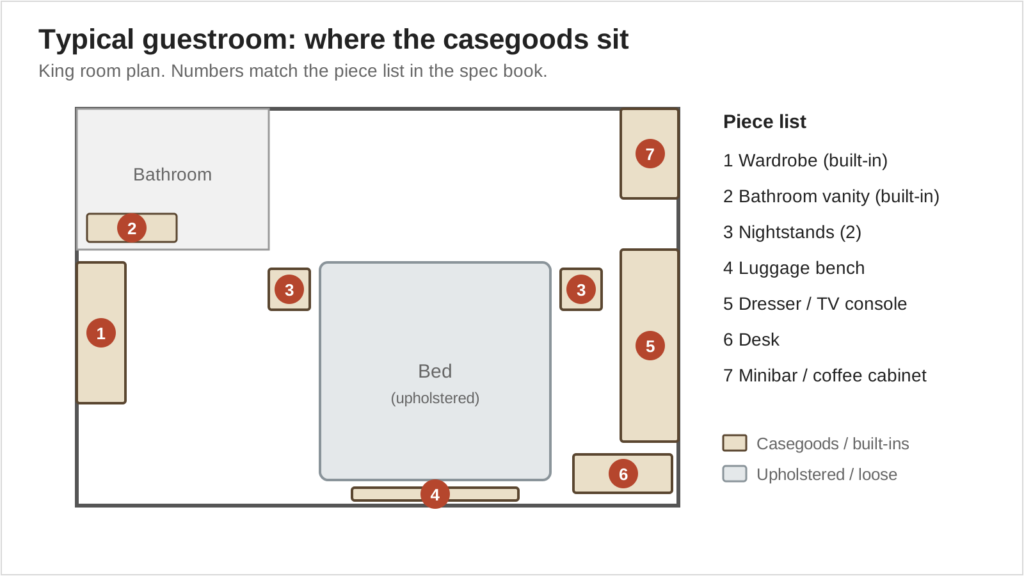
Define each of these for every room type:
- Drawings and dimensions. Every piece, per room type, with sizes, tolerances, and mounting details.
- Materials. Core boards such as plywood or MDF, with thickness and grade, plus any solid wood elements.
- Surfaces and finishes. Laminate, HPL, veneer, lacquer, or other finishes, with color references, sheen, and edge treatment.
- Hardware. Drawer slides, hinges, pulls, and fasteners, with a brand or performance level.
- Construction. Joinery, back panels, edge banding, and whether pieces ship assembled or knocked down.
- Durability needs. Hospitality use is heavy, so specify abuse resistance for finishes, edges, and moving parts, along with any test requirements from the brand or owner.
- Integrations. Power and USB, lighting, mirrors, glass, and wall-mounting details.
- Accessible rooms. Reach ranges, knee space, and clearances, confirmed with the architect.
- Compliance. Emissions documentation for composite wood, plus brand or code requirements.
- Packaging and labeling. Crating level, protection, and identification by room and floor.
- Spares. Attic stock for repairs and later replacements.
Three of these decide how the project goes.
Durability. A guestroom dresser is opened thousands of times a year and hit by luggage every day. If the spec only names a color, suppliers will quote a residential build. Put the abuse-resistance level for edges, corners, and drawer slides in writing.
Accessible rooms. The number of accessible rooms is set by the total room count. Roll-in showers are required once a facility has more than 50 guest rooms, and accessible rooms must be spread across room classes, so you may need an accessible variant of several casegoods pieces, not just one.
Compliance. Composite wood panels sold in the U.S. need to meet formaldehyde limits. EPA states that TSCA Title VI limits are set at the same levels as CARB Phase 2, and that products made in or imported into the U.S. after March 2019 must be certified and labeled as TSCA Title VI compliant. Ask every hospitality furniture supplier for documents on the specific boards used for your project, not a general statement.
Learn more: Cabinet Specifications & CAD Drawings for Architects and Designers
The Prototype or Mock-Up Room
A prototype is where the paper becomes a real piece in a real room. It is the cheapest place to find a problem, and the most expensive place to skip.
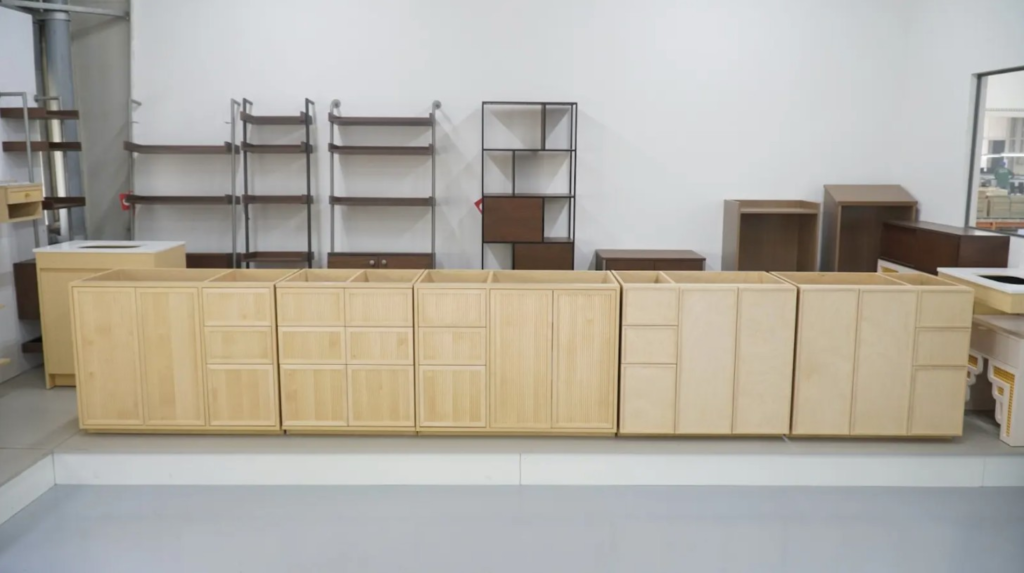
Why it matters. A prototype lets the owner, designer, and brand confirm proportion, finish, hardware, and function before production starts. Photos and drawings cannot show you how a drawer feels or how a color reads under warm room lighting.
What to review.
- Dimensions against drawings.
- Finish and color under room lighting.
- Edge and corner quality.
- Drawer and hinge operation.
- Hardware.
- Installation details.
Sign-off. Record approval in writing, with photos, measurements, and notes. The approved prototype then becomes the production reference, and any argument later is settled against it.
Keep a reference sample. Ask the manufacturer to retain a matching piece. Months into production, a physical standard beats any email thread.
Allow for revisions. Build time for at least one round of comments into the schedule. Few prototypes pass on the first try, and that is normal.
Production follows the approved version. Any change after sign-off should be documented, priced, and re-approved. A hotel guest room casegoods manufacturer that accepts informal changes in production is the one who delivers rooms that do not match, so ask how change requests are logged and approved.
Learn more: Sample Program for Wholesale Buyers: How to Evaluate Quality Before Bulk Ordering
Planning Production Around the Opening Date
The opening date is fixed and everything else is negotiable. Plan the order backward from it.
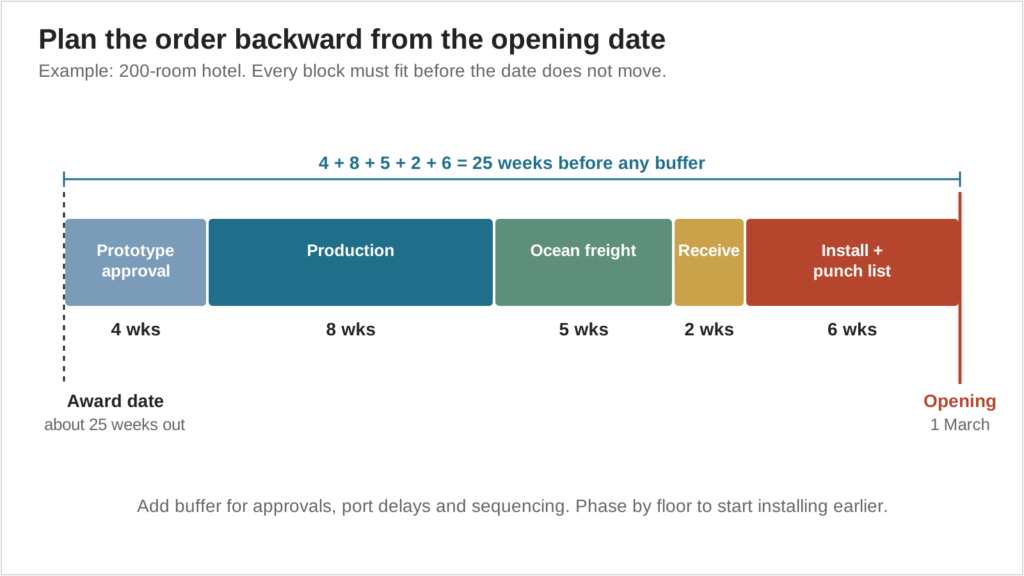
- Work backward from opening. Subtract installation and punch list time, receiving and warehousing, shipping, production, prototype approval, and drawing review.
- Phase by floor or block. Splitting production and delivery by floor or building lets installation start earlier and reduces storage.
- Control batch consistency. Rooms on different floors or phases still need matching color and sheen, so ask how finish consistency is managed between batches.
- Check capacity. The manufacturer should show how it schedules a multi-room order alongside other work.
- Buffer for risk. Allow slack for approvals, port delays, and installation sequencing.
- Agree on schedule changes. Settle who pays for rush work or re-sequencing before it happens.
Here is a worked example. A 200-room hotel opens on 1 March. Installation and punch list take 6 weeks, receiving and warehousing 2 weeks, ocean freight 5 weeks, production 8 weeks, and prototype approval 4 weeks. Within that approval time, a sample takes about 2 weeks to make and about 1 week to ship, which leaves about 1 week for the owner and designer to review it. That adds up to 25 weeks, so the award date is no later than early September, before any buffer. Most teams only discover this when the supplier search starts in November.
Batch consistency deserves its own question. Finish drift between a floor-3 batch and a floor-7 batch is visible the day the guest walks the corridor. Good hotel casegoods manufacturers can explain how they match color between runs, usually with a retained master sample and a defined tolerance.
Learn more: Lead Time for Wholesale Cabinet Orders: From Factory to Delivery
Quality Control and Pre-Shipment Inspection
Hotel casegoods manufacturers can fix a defect in the factory in an hour. Fixing it in a hotel corridor costs a week and a flight.
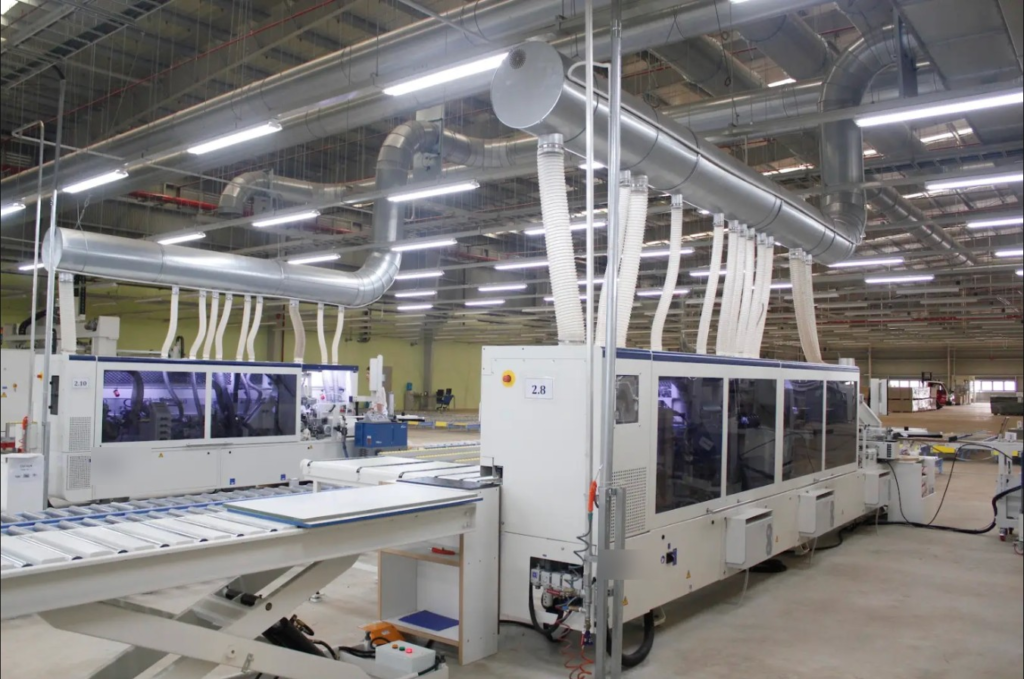
- Inspection stages. Material checks, in-process checks on dimensions and finish, and a final inspection against the approved specification.
- Defect classification. Agree on how critical, major, and minor defects are defined and what is acceptable.
- Sampling and acceptance. Confirm the sampling method and acceptance criteria before production starts.
- Third-party inspection. Many hospitality buyers hire an independent inspector for pre-shipment checks, and reputable hotel casegoods manufacturers accept this.
- Documentation. Ask for inspection reports and photos before shipment, and agree what happens if an order fails.
Defect classes are where disputes start, so settle them early. A common convention under ISO 2859-1 sampling plans is a 0% limit for critical defects, 2.5% for major, and 4.0% for minor, though your brand standard may set stricter numbers. What matters is that the buyer and the factory use the same table before the first piece is cut.
Learn more: Cabinet Quality Control Process: How Bulk Orders Are Inspected Before Shipping
Packing, Labeling, and Logistics for FF&E
A hotel does not receive furniture. It receives rooms. Pack the order the way it will be installed.
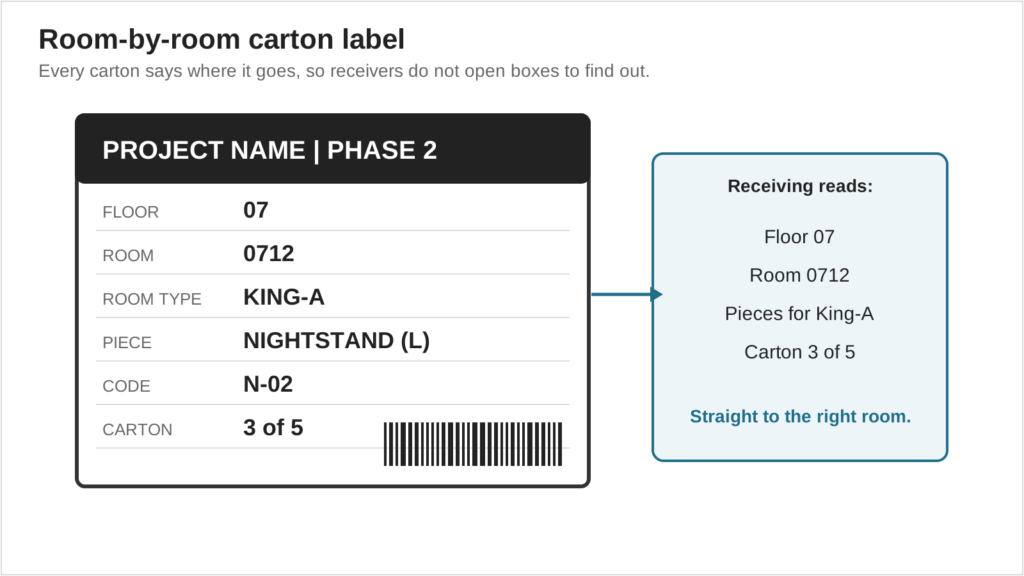
- Pack by room. Pieces for each room should travel together, with labels showing the room number or type, floor, and piece identification.
- Match the packing list to the order. It should show quantities by room type, so receivers can check against the schedule.
- Protect finishes. Crating, corner protection, and moisture barriers reduce damage in transit.
- Container planning. A loading plan helps fit rooms and phases into containers sensibly.
- Shipping terms. FOB, CIF, and DDP divide cost and responsibility differently, so compare them on landed cost.
- Receiving and warehousing. Coordinate with the FF&E warehouse or the property on inspection, storage, and delivery sequencing.
- Installation support. Diagrams, instructions, and a point of contact reduce errors during installation.
Practical tip: ask each supplier on your shortlist to show a packing list from a past project. A good one reads like a room schedule. A poor one lists "nightstand x 400" and leaves your receivers to sort it out on a loading dock.
Learn more: How Many Kitchen Cabinets Fit in a 20ft/40ft Container?
Pricing and Commercial Terms
Two bids from hotel casegoods manufacturers can differ by 15% and still describe the same product. The difference is usually in what each one leaves out.
- Pricing basis. Per piece, per room type, or per key. Make sure every bid uses the same basis.
- What is included. Packaging, labeling, spares, and delivery terms differ between bids.
- Price validity. Confirm how long pricing holds and what can change it, such as materials, freight, or duties.
- Change orders. Understand how quantity, finish, or design changes after approval are priced.
- Payment structure. Deposits and milestone payments are common, so confirm them and the checkpoints tied to each.
- Warranty and claims. Get coverage terms, the claim procedure, and the handling of damaged pieces in writing, including how replacements are shipped.
- Documentation for owners and lenders. Certifications, inspection reports, and compliance paperwork may be required at closeout.
Put the bids into one sheet with the same basis, then add freight, duties, and spares to each. The cheapest bid on day one is rarely the cheapest on day 200, which is why spares and crating should be priced as separate lines. Hotel furniture manufacturing quotes that exclude spares and crating can look 8% lower until the missing lines are added back.
7 Checks Before You Bid With a Casegoods Manufacturer
Brochures from hotel casegoods manufacturers look alike. These seven checks tell them apart.
1. Hospitality References and Capability
Look for experience with hotel or hospitality-style projects, and ask which room types and pieces were produced. Hotel casegoods manufacturers that have built 300 identical guestrooms have solved problems a residential supplier has never met.
2. Drawings and Customization
The hotel casegoods manufacturers on your list should build from your drawings and spec book and engineer the details, such as hardware and integrations. Ask to see a shop drawing from a previous job, not a catalog page.
3. Prototype Process
Ask how prototypes are built, reviewed, revised, and approved, and how long each round takes. The answer shows how a supplier behaves under schedule pressure.
4. Materials, Finishes, and Compliance
Check available boards and surfaces, durability testing, and emissions documentation. If a project targets green building credits, FSC documentation has to match the order, not just the factory.
5. Capacity and Schedule
Ask for a realistic lead time from approval, phased production, and a plan for batch consistency. Hotel casegoods manufacturers that say "yes" to every date have not looked at your order.
6. QC, Packing, and Labeling
Review the inspection process, packing by room, and loading plans. Ask whether third-party inspectors are welcome.
7. Commercial Terms and Support
Compare the pricing structure, payment terms, warranty, spares, and a named point of contact for your project A quick answer on a Tuesday often saves a week of schedule.
Hotel casegoods manufacturers that score well on all seven are rare. Most owners decide which three matter most for their brand and hold the supplier to those in writing.
Learn more: Bulk Cabinet Supply for HOA & Multifamily Renovation Projects
Common Mistakes on Hospitality Casegoods Orders
Most of these show up in the first month of the supplier search, not at the factory.
- Starting the supplier search too close to the opening date
- Bidding without a clear spec book, so quotes are not comparable
- Skipping or rushing the prototype approval
- Not defining durability and finish performance requirements
- Allowing finish drift between production batches
- Ignoring room-by-room packing, then sorting pieces at the property
- Assuming duty and tariff treatment instead of verifying it
- Forgetting spares and attic stock
If you only fix one, fix the first. A search for hotel casegoods manufacturers that starts early gives you room to correct the other seven.
An RFQ Checklist for Hotel Casegoods
Use this list when you send an RFQ to hotel casegoods manufacturers, and again before you award.
- Property type, brand, and room count by room type
- Piece list per room, with drawings and a spec book
- Materials, finishes, hardware, and performance requirements
- Compliance and documentation needs
- Prototype and approval expectations
- Target schedule, including opening date and phasing
- Delivery location and shipping terms (FOB, CIF, DDP)
- Packing, labeling, and spares requirements
- Payment and warranty expectations
- Inspection approach, including third-party inspection if planned
Questions to Ask a Manufacturer
These questions get past the sales deck and show how hotel casegoods manufacturers actually work, and they suit any hospitality furniture manufacturer.
- What hospitality or large-room-count projects have you completed, and what did you supply?
- Can you build from our drawings and spec book, and engineer the details?
- How does your prototype process work, and how long does approval typically take?
- What materials, finishes, and hardware do you offer, and what compliance documents can you provide?
- What is your lead time from drawing approval, and can you phase production by floor?
- How do you control finish consistency across batches?
- How do you pack, label, and load pieces by room?
- What inspection process do you use, and do you accept third-party inspection?
- What are your warranty and claims terms, and how do you handle spares?
Supplier Spotlight: Casta Cabinetry
Founded in 2002, Casta is a Vietnam-based furniture and cabinet manufacturer with over two decades in the industry, and 100% of Casta's products are made in Vietnam. As a hospitality furniture manufacturer, Casta builds to the owner's spec book and the designer's drawings. Casta's casegoods category and wider furniture range include side tables, coffee tables, bookshelves, shoe storage, dining tables, buffets and sideboards, dressers, and wardrobes, and Casta also builds custom furniture from a buyer's sketches or CAD files, with shop drawings and a quotation based on your requirements.
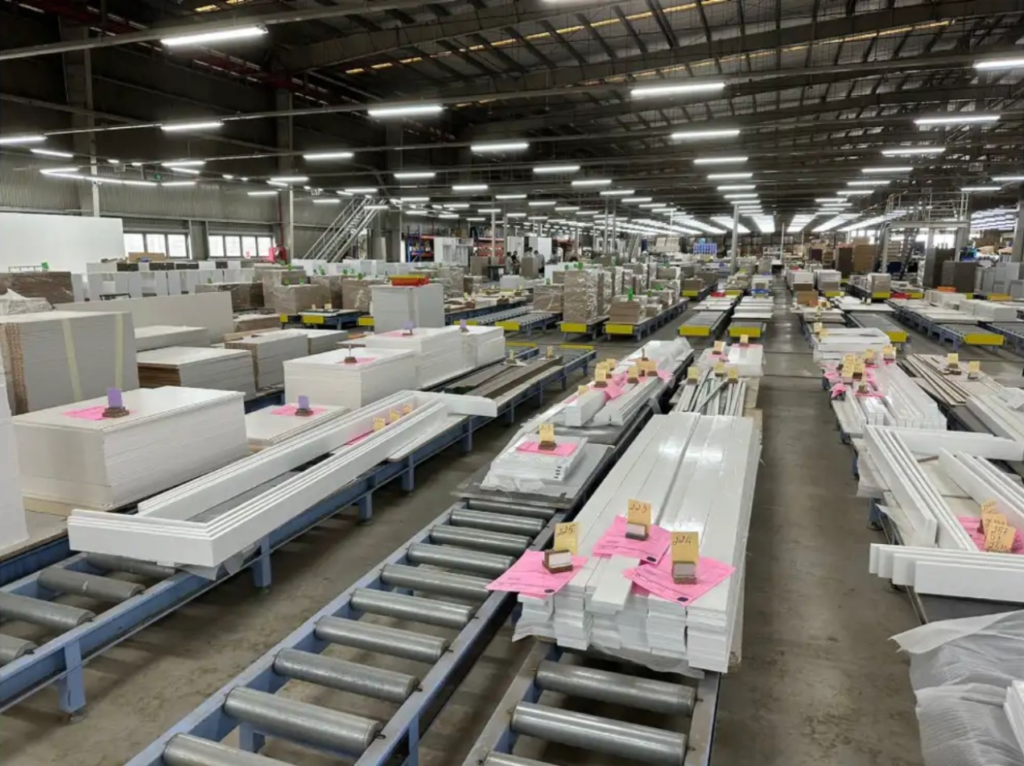
Casta's hospitality experience includes the 237-room Wink Hotel in Ho Chi Minh City, where Casta supplied built-in and loose furniture, and Vinpearl Luxury in Da Nang, a Vingroup residential and hospitality development, where Casta supplied kitchen cabinets, wardrobe cabinets, and kitchen equipment. Casta has also worked with major developers in Vietnam, such as Vinhomes, Masterise Homes, and Gamuda Land.
The OEM process runs through quotation request, price approval, sample model, purchase order, pre-production samples, mass production, delivery, and after-sales, with samples offered until clients are satisfied. Packages are labeled according to the drawings you provide, floor by floor and unit by unit, which supports room-by-room organization, and goods can ship Flat Pack or Fully Assembled. A dedicated QA/QC team checks finished goods, measurements, and quantity against your specification, and a dedicated planning team coordinates shipping.
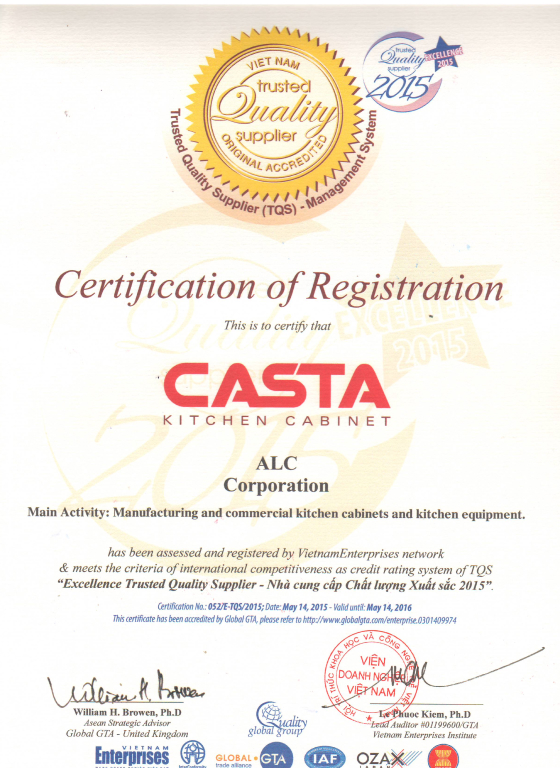
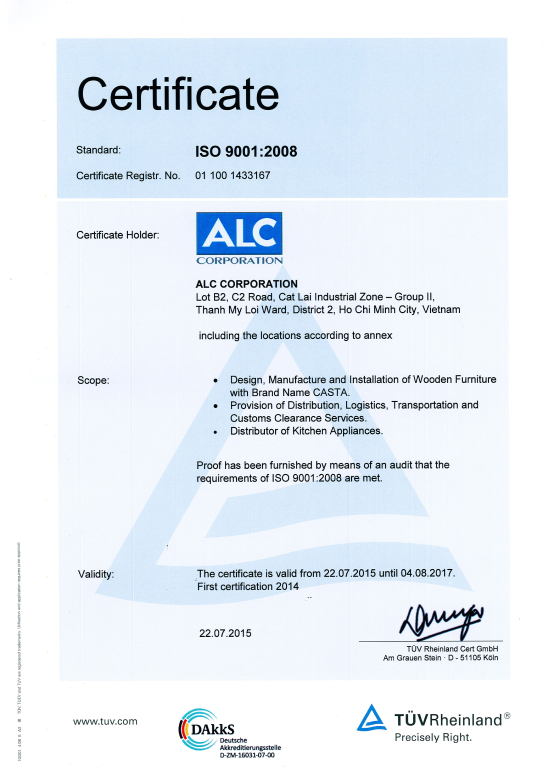
Casta operates two factories spanning over 100,000 m², using European machinery from brands including SCM, Homag, and Cefla, with roughly 90% automation, ERP-managed production, and a standard lead time of 45 to 60 days from shop drawing approval. A quotation takes about 3 to 5 days once Casta has the full product information and specification, and a sample takes about 14 to 21 days, depending on material availability. Casta is certified under BSCI, BSI, TCVN ISO 9001:2015, and KCMA, with materials sourced to meet standards including European E1, JIS, CARB, and FSC. Over 80% of Casta's output is exported, mainly to the U.S.
Learn more: Casta's outstanding international projects
During the bid stage, confirm Casta's experience with your brand standards, the exact guestroom pieces in scope, durability testing, and compliance documentation.
Frequently Asked Questions
Who are the leading hotel casegoods manufacturers in Vietnam?
What is the difference between casegoods, built-ins, and loose furniture in FF&E?
How does a prototype or mock-up room work for hotel furniture?
How long does it take to manufacture and deliver hotel casegoods?
Can hotel casegoods manufacturers pack and label furniture by hotel room?
What documents should hospitality buyers request from hotel casegoods manufacturers?
Do duties and tariffs apply to hotel furniture imported from Vietnam?
Conclusion
Hotel casegoods programs succeed when drawings are clear, a prototype is approved and kept as the reference, production is scheduled backward from the opening date, and goods are inspected, packed by room, and received cleanly. The choice among hotel casegoods manufacturers is mostly a choice about process.
Procurement teams should compare bids from hotel casegoods manufacturers on the same basis, verify compliance and duty treatment, and confirm warranty and spares in writing. Casta Cabinetry offers custom manufacturing from your drawings, hospitality project experience in Vietnam, a sample-first OEM process, room-by-room labeling, and a dedicated export planning team, which makes it a good starting point for hospitality developers and procurement firms evaluating a Vietnam-based supplier.
Contact Casta Cabinetry's team with your room schedule, drawings, and timeline to request a prototype discussion and a quotation.





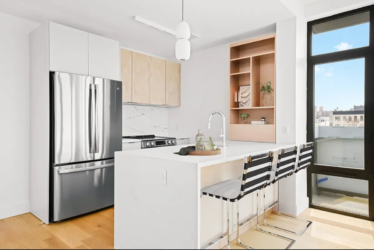
Pantry & Tall Cabinet Dimensions: Heights, Depths, Widt...
Tall cabinets anchor a kitchen layout, and the pantry cabinet dimensions you choose decide whether the run lines up with...
10/24/2026 | David Nguyen
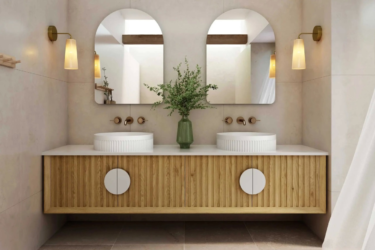
Floating (Wall-Hung) Vanities for Multifamily & Hotel P...
A floating vanity is one of the quickest ways to make a small bathroom feel lighter, and in a hotel or an apartment buil...
10/22/2026 | David Nguyen
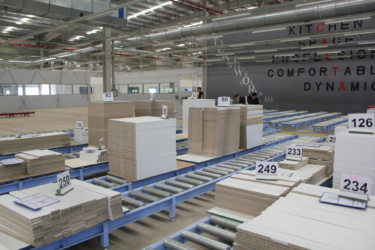
TSCA Title VI vs CARB P2 vs E1: Formaldehyde Rules for US Im...
Quotes from overseas suppliers often say a cabinet is “E1,” “CARB P2,” or “TSCA Title VI c...
10/20/2026 | David Nguyen

Wardrobe & Closet Cabinet Manufacturer for Developers (...
Wardrobes get specified last on most projects, yet they cover a lot of wall, repeat in every bedroom, and show up in eve...
10/16/2026 | David Nguyen
Pantry & Tall Cabinet Dimensions: Heights, Depths, Widt...
Tall cabinets anchor a kitchen layout, and the pantry cabinet dimensions you choose decide whether the run lines up with...
10/24/2026 | David Nguyen
Floating (Wall-Hung) Vanities for Multifamily & Hotel P...
A floating vanity is one of the quickest ways to make a small bathroom feel lighter, and in a hotel or an apartment buil...
10/22/2026 | David Nguyen
TSCA Title VI vs CARB P2 vs E1: Formaldehyde Rules for US Im...
Quotes from overseas suppliers often say a cabinet is “E1,” “CARB P2,” or “TSCA Title VI c...
10/20/2026 | David Nguyen
Wardrobe & Closet Cabinet Manufacturer for Developers (...
Wardrobes get specified last on most projects, yet they cover a lot of wall, repeat in every bedroom, and show up in eve...
10/16/2026 | David Nguyen
Contact us
Casta is always ready to listen and answer all customers' questions